
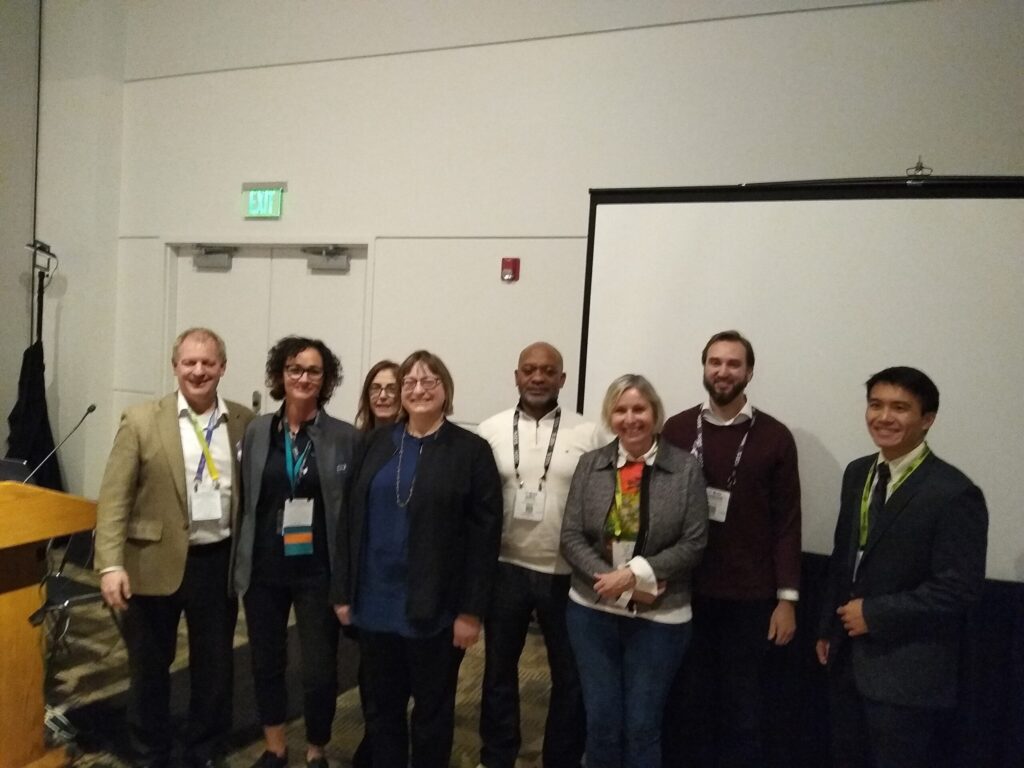
Origins of the Computational Approaches for Cancer Workshop (CAFCW)
Cancer touches everyone. In 2022, approximately 20 million cancer cases were newly diagnosed and 9.7 million people died from the disease worldwide[1]. Countless new discoveries and therapies are emerging but cancer still casts a shadow on the lives of too many families across the globe.
Established in 2015, the CAFCW workshop brings together top national and international leaders in biomedical research, data science, and HPC to identify and overcome the complex and evolving challenges in cancer.
Past participants have included a former NCI director, physician scientists from leading cancer centers, and HPC experts from the US Department of Energy who have pioneered solutions to complex scientific problems using the world’s most powerful supercomputers.
The CAFCW workshop gives voice and community to students and international leaders alike who are passionate about breaking down complex cancer challenges and pushing new frontiers to develop innovative approaches and AI tools to advance cancer research and improve people’s lives.
CAFCW invites the cancer and HPC communities to converge at SC, interact, and share insights to drive innovation. Please join us! Register for the CAFCW26 workshop!
[1] American Cancer Society, Global Cancer Facts and Figures, 5th Edition, Atlanta: American Cancer Society; 2024.
To join the community and add your name to the mailing list, contact us at cafcw-info@cafcw.org.
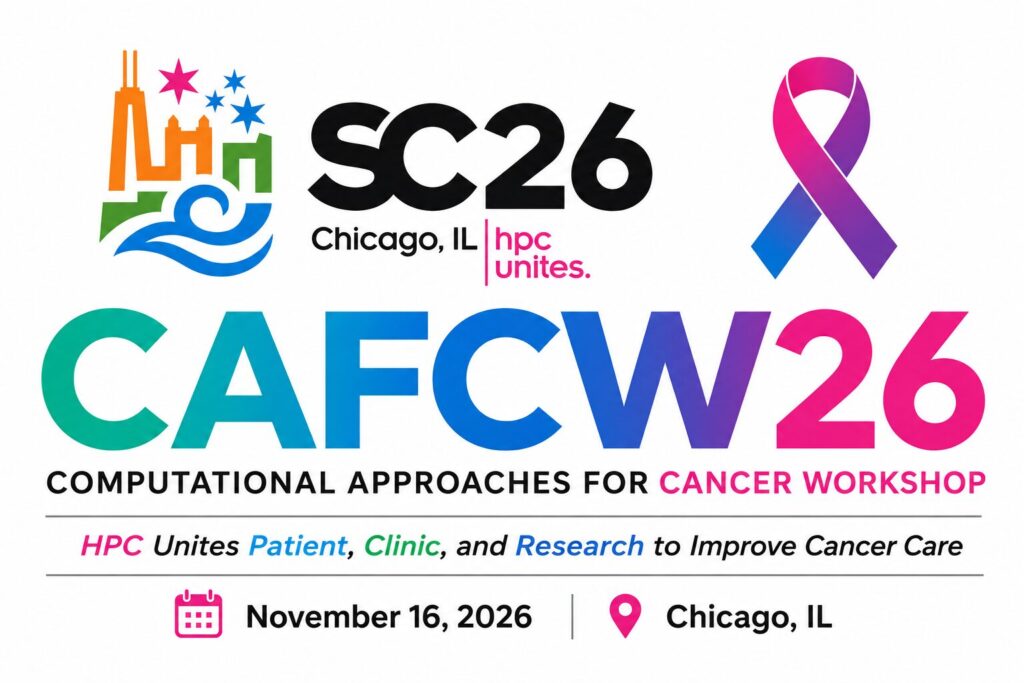
CAFCW 2026 Organizing Committee
- Eric Stahlberg, CAFCW Workshop Co-Founder, Institute for Data Science in Oncology, UT MD Anderson
- Patricia Kovatch, CAFCW Workshop Co-Founder, Icahn School of Medicine, Mount Sinai Health System
- Sean Hanlon, National Cancer Institute
- Lynn Borkon, Institute for Data Science in Oncology, UT MD Anderson
- James Lillard, Morehouse School of Medicine
- Stephen Litster, Google (formerly)
- Adam Spannaus, Oak Ridge National Laboratory
- Andrea Hawkins-Daarud, Institute for Data Science in Oncology, UT MD Anderson
2026 Program Committee
Thank you for sharing your expertise by reviewing submissions!
- Boris Aguilar, Thorsson-Shmulevich Lab, Institute for Systems Biology
- Belinda Akba, Department of Chemical Engineering, University of Illinois at Chicago
- Jeffrey C. Buchsbaum, Radiation Research Program, National Cancer Institute
- Ernesto Bueno da Fonseca Lima, Center for Computational Oncology, Oden Institute, University of Texas
- Sriram Chandrashekaran, Biomedical Engineering, University of Michigan
- Ansu Chatterjee, Department of Mathematics and Statistics, University of Maryland Baltimore County
- Andrea Hawkins-Daarud, Institute for Data Science in Oncology, UT MD Anderson
- Khanh N. Dinh, Irving Institute for Cancer Dynamics, Columbia University
- Daniel Salinas Duron, Department of Mathematics and Computer Science, Mount St. Mary’s University
- Catherine Fang, Integrated Innovation Institute, Carnegie Mellon University
- James Glazier, Biocomplexity Institute, Indiana University Bloomington
- David A. Hormuth, Oden Institute for Computational Engineering and Sciences, The University of Texas at Austin
- Florence Hudson, Northeast Big Data Innovation Hub, Columbia University
- Ai Kagawa, Computing and Data Sciences Directorate, Brookhaven National Laboratory
- Jerry S. H. Lee, Ellison Institute of Technology and University of Southern California
- Meifeng Lin, Computing and Data Sciences Directorate, Brookhaven National Laboratory
- Stephen Litster, High Performance Computing Healthcare and Life Science, Google (ret.)
- AnaMaria Lopez, Sidney Kimmel Cancer Center, Thomas Jefferson University
- Wentao Ma, Department of Biomedical Engineering, Duke University
- Amanda Paulson, University of California, San Francisco
- Sanket Rane, Irving Institute for Cancer Dynamics, Columbia University
- Gundolf Schenk, Bakar Computational Health Sciences Institute, University of California, San Francisco
- John Paul Shen, Cancer Prevention & Research Institute (CPRIT), UT MD Anderson Cancer Center
- Thomas Steinke, Distributed Algorithms and Supercomputing Department, Zuse Institute, Berlin, Germany
- Ronald C. Taylor, Developmental Therapeutics Program, National Cancer Institute
- Thomas E. Yankeelov, Center for Computational Oncology, The University of Texas at Austin
If you are interested in joining the CAFCW26 Program Committee, please contact us at cafcw-info@cafcw.org.
Advancing Computational Cancer Research
Discover the prestigious honors that highlight our impact and commitment to innovative cancer research through computational methods.

Best Student Submission
Awarded for best submission by students entering the computational cancer field.

Excellence in Scientific Collaboration
Recognizes outstanding efforts to foster interdisciplinary partnerships within the cancer research community.

Impact in Computational Oncology
Celebrates significant contributions to the development of computational tools that enhance oncology research precision.